A Statement of Purpose


Since 2012 I have been responsible for
the garden at the Pry House Field Hospital Museum on Antietam National Battlefield. The Pry House garden began as a 19th century style medicinal and kitchen garden, including medicinal plants, herbs, and vegetables. As close as possible, these plants mirrored those available to the Pry Family in the 1860s, meaning heirloom varieties. Since then, the garden has transformed to focus exclusively on medicinal plants, becoming an exhibit of the flora that was employed by military and civilian caregivers in the Civil War Era.

I am strictly an amateur, with no real experience in growing a garden. The purpose of this blog is to document my experiences as I learn by doing. It is anything but authoritative and I welcome any comments and advice for a greenhorn. Please be kind!
Showing posts with label museum. Show all posts

Tuesday, July 29, 2014

Marshmallows and Beetles

This year the marshmallows which I sowed as seeds two years ago have grown gigantic. They are almost too big for their space!


The common marshmallow, Althaea officinalis, is native to North Africa, but has been used by many cultures for millennia, including the ancient Romans, Greeks, and Egyptians, all of whom ate the roots for food.  The extract, sap, and pith of the plant have also been used in confections since ancient times.


Today's fluffy white marshmallows that we roast over the campfire do not contain any part of the Althaea officinalis plant, but earlier versions of marshmallow candy did. Sap extracted from the roots was whipped with sugar to create a spongy, chewy treat. Eventually, egg whites and/or gelatin mixed with starches replaced the labor-intensive and expensive process of extracting marshmallow sap, but the name remains.


Marshmallow plants were used as a medicine long before they were a dessert. In fact, their medicinal origins are likely connected to their confectionary use. The plant's extract seems to have a healing effect when applied to irritations and inflammations, especially in mucous membranes. It can form a thick gel that helps coat the throat, esophagus, stomach, etc. It has traditionally been a remedy for sore throat, cough, and the painful irritations of asthma, bronchitis, and other respiratory ailments. When sap or other extracts from the plant were mixed with honey to sooth sore throats it created a crude early form of marshmallow confection.

Marshmallow Root
Marshmallow sap has also been used for thousands of years as an effective emollient, helping to treat irritations, rashes, and minor wounds of the skin. It has also been taken internally to inflamed bowels, stomach ulcers, and other digestive ailments, as well as inflammation of the bladder and urinary tract.

Still in use today

In the Civil War Era, marshmallow was mainly taken internally as a tisane. The roots were dried and chopped, then boiled in water. It was used for all of the above purposes, but mostly commonly to sooth sore throats and the irritations of respiratory diseases.
www.coffeeandtea.com

While the plants in the garden are flourishing this year, they are coming under heavy attack by hundreds of Japanese beetles. This is a problem I have not had before in the garden, even though several of the other plants, like hops, are supposed to be a magnet for the pests. Still, they really seem to like the marshmallow.


The Japanese beetle was accidentally introduced to America just over a hundred years ago. Since then, they have been a major pest to agriculture and flower gardens alike. I remember the awful nuisance they made on my father's roses every year when I was growing up.
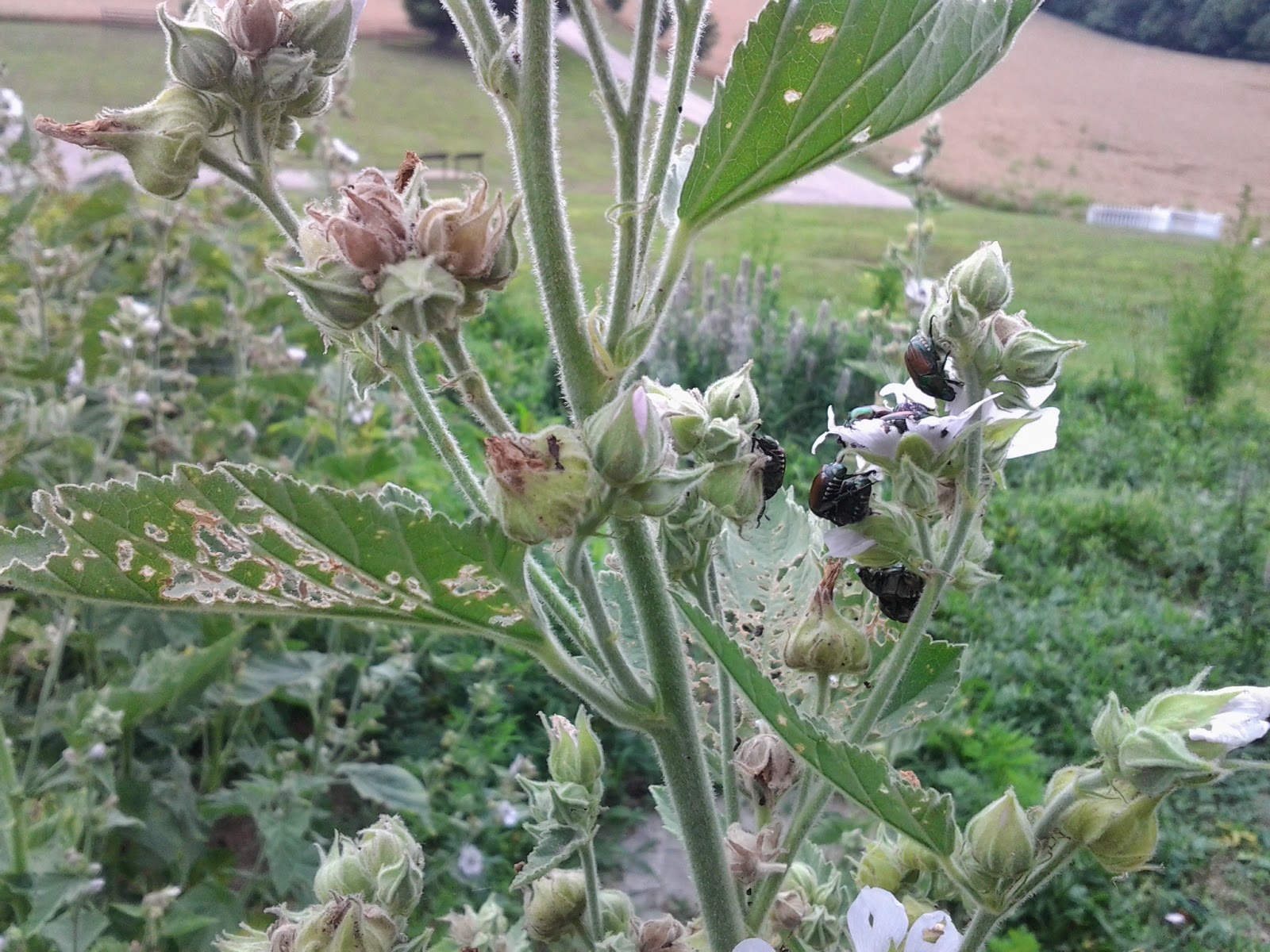

Despite how many beetles are using the mallows as a breeding ground, they don't seem to be doing any major damage and the plant is taking it in stride. I decided not to try and do anything about the little invaders, as it would be a lot of work or might have unintended consequences, and the plants don't seem to be suffering too much. They are unsightly though, and I hope they might possibly be fewer in number next year.


Tuesday, July 1, 2014

Blooming Black-Eyed Susans

It is a beautiful early summer day on the Antietam Battlefield! The birds are singing, the bees are buzzing, and the flowers are in bloom!


Here in the Pry Medicinal Garden, our healthy crop of Black-eyed Susans are in peak bloom and looking gorgeous!

The common Black-eyed Susan, or Rudbeckia hirta, is native to a wide swath of Eastern and Central United States. It is type of daisy and coneflower, alternatively known as Golden Jerusalem, Gloriosa Daisy, or Yellow Ox-Eye Daisy. The Black-eyed Susan is, however closely related to another plant in the Pry Garden, the Purple Coneflower, Echinacea purpurea. The two were once listed in the same genus.


The Black-eyed Susan has long been associated with Maryland and was officially designated as the state flower in 1918. The flower's association with Maryland stems not only from its ubiquitous summer blooms in open places across the state, but also for its colorful resemblance to the yellow and black Calvert family crest. Cecil Calvert, 2nd Lord Baltimore, founded Maryland in 1634, though he never personally set foot there.
The modern Maryland state flag, featuring the yellow and black Calvert crest

Cecil Calvert, 2nd Lord Baltimore


The root of the Black-eyed Susan plant has been used medicinally for untold centuries, beginning with eastern Native Americans. The plant was not officially adopted by either the Union or Confederate Medical Departments, but it continued in popular use as a folk medicine.


Rudbeckia hirta roots

Black-eyed Susan root is and was most commonly used similarly to its cousin the Purple Coneflower. When ingested, it is believed to boost the body's immune system and reduce they symptoms and duration of common diseases like cold and flu. It is also a mild astringent that might be used to relieve minor swelling and skin irritations. It is also believed to be a mild diuretic, promoting urination and removing water from the body. Some accounts indicate that some native peoples may even have used Black-eyed Susan root as an external treatment for poisonous snakebites, though the efficacy of that seems doubtful.


To most people today, the Black-eyed Susan is simply a beautiful summer flower that can be found growing wild and in flower gardens, especially here in Maryland.

Tuesday, July 23, 2013

Chicory and Other Weeds

My blog has been on a bit of an unplanned hiatus for the past month or so, but I am returning to posting this week. We have seen a great increase of visitation here at the Pry House lately, and that has kept us quite busy! I am glad to also say that I survived 10 days in Gettysburg for the 150th anniversary of the battle earlier this month! It was a memorable experience, but one I am glad I will not have to repeat for a while!

Gettysburg's Lutheran Theological Seminary opened Schmucker Hall as a new museum on July 1st, the 150th anniversary of its appropriation as a field hospital. It's exhibits feature several artifacts on long term loan from the National Museum of Civil War Medicine.

If you did not hear it already, while I was at Gettysburg I was a guest on one of my favorite public radio programs, The World, produced by the BBC and PRI. I talked about how Gettysburg was an important moment in the history of emergency medicine and explained how there is a direct link between the battle and the Boston Marathon bombings 150 years later. Check it out here:

Kyle's Interview for The World


The fictitious portrayal of a field hospital in the Gettysburg Cyclorama

Since I was away all that time though, the garden has been filled with weeds! It has been a lot of work just trying to catch up with all of those weeds and get the garden back into some semblance of a presentable appearance. It doesn't help that it has been very hot and humid here lately.


One weed that we are all seeing a lot of right now is Chicory. If you don't know what chicory is, you are undoubtedly already very familiar with it, but just didn't know what it was called. At this time of year we see it growing everywhere from the side of rural farm roads and highways to vacant urban lots. It blooms in distinctive powder blue flowers, sometimes called a Blue Daisy or Blue Dandelion. Many people seem to find it an eyesore, but I have always thought that, at least while in bloom, it's quite pretty.


Common Chicory is actually native to Europe, but has been so common in the United States for two hundred years or more that many people think of it as a native wildflower. Its most iconic use during the Civil War was as a coffee substitute for the Confederacy, which was starved of the genuine article by the Yankee blockade. For such use, the root was harvested, baked, ground and used like coffee grounds. However, while chicory has become the iconic form of Southern ersatz coffee, rye, wheat, corn, and other grains were actually far more popular coffee substitutes within the Confederates. Chicory as a coffee substitute was actually much more common in Europe during the Second World War. People have also used chicory as an animal fodder and as a human food, eating the leafy greens,which are fairly bitter.


What interests me more about chicory is its traditional medicinal use, including during the Civil War. Most substantial, I think, is its quality as an anthelmintic, meaning that it will kill and expel worms and other parasites from the body. Volatile oils in the plant make it a highly effective anti-parasite medicine and for this reason it is still a popular additive to livestock feed.

Chicory was also used to treat a variety of liver and gall bladder ailments, such as jaundice and gall stones; it was believed to stimulate a healthy production of bile. Chicory was also employed as a diuretic (promoting urination) and a laxative. It was included in digestive tonics, under the belief that it stimulates the appetite and helps to cure gastritis and other digestive ailments. It would appear that practitioners of herbal medicine still advocate the use chicory in these capacities today.


I can't say that I have ever experimented with chicory in any of these ways. Nevertheless, I think it changes our understanding and appreciating of those scrubby weeds on the side of the road when we remember how useful and valuable they have been to people not so long ago.


Wednesday, April 10, 2013

Wetting the Bed

I wanted to title this blog post as a reference to the Beatles song, "Fixing a Hole," but no one got that, so you got this rather juvenile title instead.

As I try to expand the variety of plants that are featured in the Pry House Garden, I run into a problem; many plants that were utilized by Civil War Era healers and physicians, especially the Confederate Medical Department, are not well-suited to a typical backyard garden. Some are trees, like the Flowering Dogwood or Butternut. Other popular medicinal plants prefer very wet, almost swampy conditions, like the Blue Flag Iris, the Mayapple, and the Cardinal Flower. I am not about to turn the Pry House into an arboretum, but I am willing to try making a section of the garden a home for moisture-loving plants.

Mayapple - Podophyllum peltatum

There is a great deal of information available on how to drain wet soil for making a garden, but considerably less on how to intentionally make dry ground soggy. Still, I looked around the internet and founds some pointers that I hope have led me in the right direction.


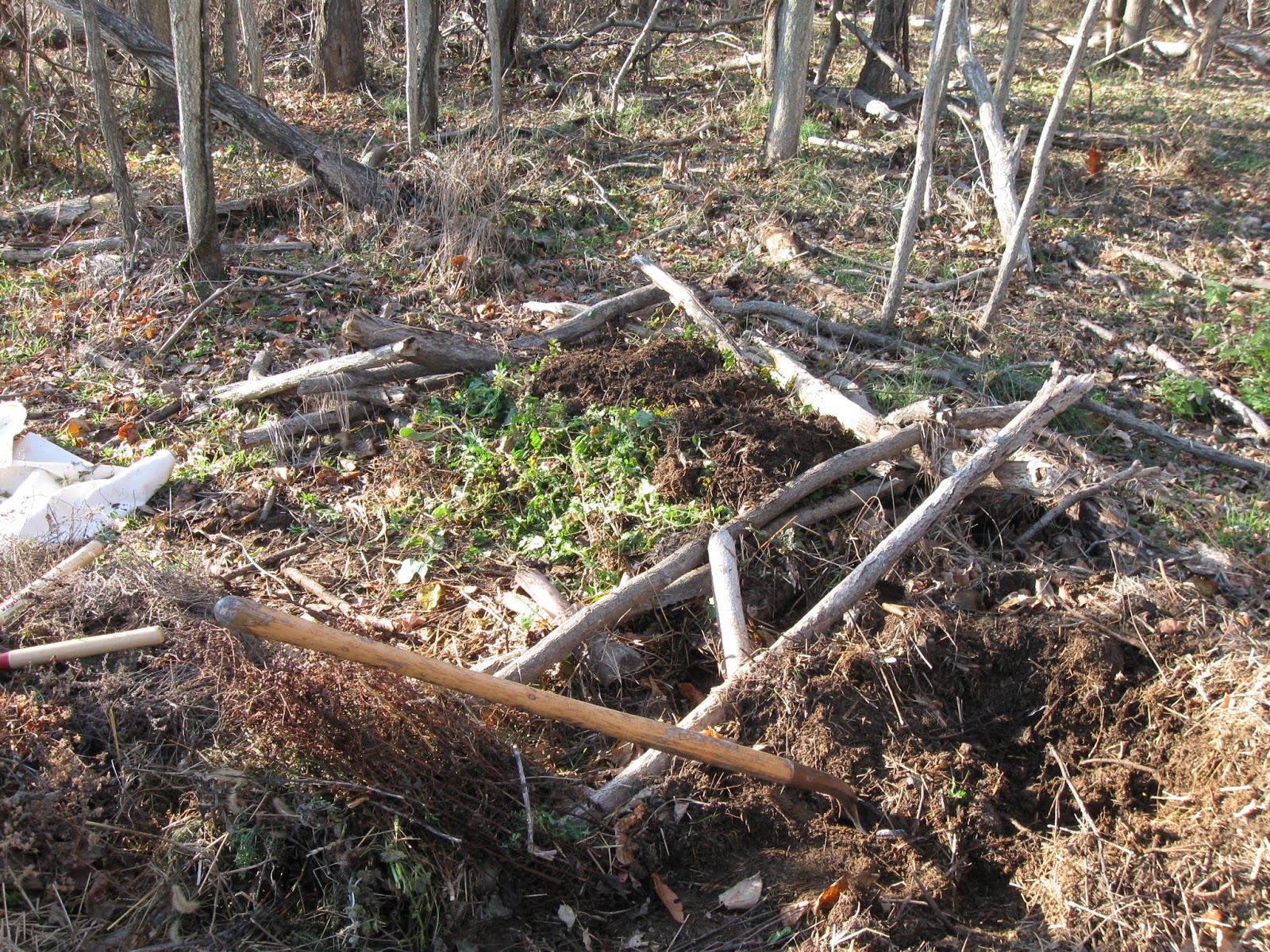
I selected a location for the new "wet bed," one of the lowers spots in garden, and laid out a rectangle of about 9 feet by 4 feet. I began by removing all of the top soil from the bed, shoveling it out by hand, and piling it on an adjacent, empty bed.


Once I reached a layer of solid clay, the digging became much more arduous. I dug down about another foot, piling all the clay separately. Solid clay doesn't make for very good gardening in most circumstances, so, I will be disposing of that elsewhere on property. Ideally, it would have probably been better to dig down further and then line sides with clay. However, I did not have the time or energy for that kind of undertaking.


After digging out the hole for about two feet, it was time to begin filling it back in. Before doing so, I lined the  bottom with jute burlap sacks. They will slowly break down over time, but for a while they will help for keep moisture in the bed.


I added the top soil back into the bed, but added grass and weeds, straw, and compost-rich soil from the compost piles. This gives the soil in the new bed a lot of organic matter, making richer helping it to retain more water.


The new bed is a little bit lower than the surrounding ground, so water should drain into it, rather than around it. I gave the whole bed a long, saturating soak with the garden hose and covered it with a thick layer of straw to help keep the dirt very wet.


With a little luck and constant heavy watering, hard work will pay off and make a home for new hydrophilic plants in the garden.


Tuesday, February 26, 2013

Boy Scouts Lend a Hand

This past weekend, we had Boy Scout Troop 279 of Point of Rocks, MD camping in the barn at the Pry Farm. They were joined by members of Troop 277 of Brunswick, MD. Troop 279 is was my home during my time as a boy scout, where I earned my Eagle Rank in 2006.


During their stay, the scouts helped me to get some work done in the garden, getting it ready for the coming spring.The boys did great work in removing lots of dead matter from the beds and sprucing up the garden paths.


We also got up on a ladder to replace the twine on the hop trellis. Unfortunately no one got a picture of that comical operation.

The scouts also took some round plastic trash cans and converted them into new compost bins for the garden. The work mostly consisted in drilling a series of holes in the cans to promote air ventilation for the compost in progress. I have been dabbling in compost before, but I think that these new bins will be a more work able system. I will talk more on that in a future post.


This is not the first time that Troop 279 has been camping at the Pry House to do volunteer work for the museum. The troop has been coming to the house for years, even before the museum was opened in 2005. Their first service project was helping to clean out decades of dirt and broken-down animal manure from the bottom of the Pry Barn. If only I had all of that dirt for the garden!


You can see me here as a boy scout, wearing my Civil War reenacting uniform. I had no idea then that I would some day work at the Pry House as it's director of programming and official gardener!

Tuesday, December 4, 2012

Milkweed Seeds

I have been doing a bit more seed collecting recently, so I thought I would talk about two plants in the same family that I have collected, one from the garden and one from the wild.

This spring, I added Butterfly Weed to the garden. Sometimes called Pleurisy Root, it is a native perennial plant in Maryland. It is more commonly seen in ornamental gardens for the appeal of its clustered orange flowers that appear in the late summer. As the name suggests, Butterfly Weed can be very attractive to various species of butterflies, including the Monarch.


The root of Butterfly Weed was used commonly by native peoples as a medicine. It was quickly adopted by white settlers and continued to serve medicinally through the 19th century. During the Civil War, the Confederate States Medical Purveyors listed Butterfly Weed as part of it's official pharmacopeia. The confederate government paid civilians to harvest the roots for use in the Southern army.

Butterfly Weed was most commonly used to treat a variety of respiratory/pulmonary ailments, including consumption (tuberculosis), pneumonia, bronchitis, and pleurisy (a painful inflammation of membranes between the lungs and chest wall). It was thought to relieve pain and inflammation and act as an expectorant. Butterfly Weed was also sometimes prescribed as a treatment for a host of unrelated conditions ranging from colds and fevers to rheumatism and venereal diseases. I have no idea if it actually worked.


The Butterfly Weed that I planted this year did not fare terribly, but it did not flourish either. I believe that this is because of soil conditions. This plant prefers to grow in gravely or sandy soils and that is not what I had given it. Perhaps I will replant it in a more appropriate soil come spring. One of the plants did do well enough, however, to produce healthy-looking seeds, which I have collected. I am going to try planting these in the spring to produce enough Butterfly Weed that I can begin harvesting some of the roots for future educational programming.

While visiting a pasture in southern Pennsylvania recently, I collected seeds from a close relative of Butterfly Weed: Common Milkweed. Both plants are members of the genus Asclepias. The genus is named for the Greek god of healing.
Asclepius, holding his snake-entwined staff

Milkweed is also a native perennial plant that is very attractive to Monarchs and other butterflies, but it's appearance is a bit different and less attractive to flower gardeners. Milkweed also likes to grow in gravely or sandy soil.

It's root was used to treat a variety of complaints. Like Butterfly Weed, it was believed efficacious in treating respiratory conditions like asthma and bronchitis, but also indigestion, diarrhea, kidney problems, menstrual cramping, dropsy (edema: swelling caused fluid retention), and other surprising ailments. Once again, I have no idea if there is any merit to these prescriptions.


Both types of seeds will require cold treatment, or stratification, to allow them to germinate when I plant them in the spring. That's another blog post!


It looks like our museum mascot Lacey was playing with my camera while I wasn't looking!


Wednesday, November 28, 2012

Clean-Up and Compost

Winter is not very far away, so I am currently working on preparing the garden for the cold months ahead. The annual plants are all done for the year and it is time to remove and dispose of them. Many of the plants are perennials, so they will come back when the weather warms in the spring. Some of these perennials can use a little maintenance now.

I had a few radishes that were forgotten and they have grow to tremendous size! Even though they were allowed to grow so long, they were neither bitter nor hot, but sweet and tasty! Perhaps this was because they grew in the cooler fall months.


I also had a few turnips that never really grew. I gave up on these ones and pulled them out. Most of the turnips were very successful though and all have been picked and enjoyed by museum staff with dinner. I am sorry that I neglected to get a picture before they were all eaten!


Perennial herbs like winter savory and oregano will remain a little bit green over the winter, but the early frosts cause them to die back a little bit. Also, I had never trimmed these plants after they flowered and went to seed.


With a sturdy pair of scissors, I cut back most of the dead matter. According to literature I have been reading, pruning the dead parts will not only improve things aesthetically, but will help to reduce disease and encourage good growth in the spring. I did not butcher the plants though, and I wanted to leave it with a little insulation and security for winter.

Other perennials will die back completely above the surface and will restart from the roots in the spring. Boneset or Thoroughwort is an example of this.


Pokeweed also dies back completely in the winter and sprouts anew in the spring. The young early greens are an old American delicacy, served much like collard greens. Picked too late though, poke greens become poisonous. These pokeweed plants had grown so thick and woody that I had to use a hatchet instead of garden shears to take them down.

Although the pokeweed was too woody and full of seeds (which might sprout in unwanted places), most of the waste matter from the garden is composted. I have been dabbling in composting this year, with limited success. All of my trimmings from this clean-up were added to the compost pile.


I chopped up all of this green matter into smaller pieces to help it break down better in the compost pile. I build the compost pile with layers of green matter, brown matter, and dirt to help the process of decomposition.

Now that winter is almost here, the compost pile will essentially come to a halt. What I am adding now will really begin to break down in the spring, I hope. Some people engage in winter composting, but this is not something I am ready to tackle, as it's a bit more work and requires some extra size or construction to keep the necessary heat in cold months. Next season I would like to engage more seriously in  the compost pile.

Most experts have their own opinion on winterizing garden plants, and they certainly don't always agree. I have tried to follow the best advice I could find in this regard, but it is very much a learning process. Your constructive advice is always appreciated!