A Statement of Purpose


Since 2012 I have been responsible for
the garden at the Pry House Field Hospital Museum on Antietam National Battlefield. The Pry House garden began as a 19th century style medicinal and kitchen garden, including medicinal plants, herbs, and vegetables. As close as possible, these plants mirrored those available to the Pry Family in the 1860s, meaning heirloom varieties. Since then, the garden has transformed to focus exclusively on medicinal plants, becoming an exhibit of the flora that was employed by military and civilian caregivers in the Civil War Era.

I am strictly an amateur, with no real experience in growing a garden. The purpose of this blog is to document my experiences as I learn by doing. It is anything but authoritative and I welcome any comments and advice for a greenhorn. Please be kind!

Wednesday, March 13, 2013

Seed-Starting Time Again.

I did not post this blog yesterday because I was away in Washington, DC at the Smithsonian American Art Museum. It was my great privilege to take a private tour of their current exhibit, "The Civil War and American Art," with the museum's senior curator of painting and sculpture, Eleanor Jones Harvey. Because I had been involved with our recent exhibit, "Bringing the Story of War to Our Doorsteps," based around "The Dead of Antietam" photography of Alexander Gardner, I was asked to meet Dr. Harvey and take an intimate look at their wonderful exhibit at the Smithsonian. If you have an opportunity, please do stop in at the Smithsonian American Art Museum to see their Civil War exhibit. It is much more than just a collection of Civil War paintings; rather, it takes a wider view of art during the period and how the war impacted the creation and reception of artwork.

Outside of stuffy museum galleries, it really feels like spring! As temperatures rise and the Sun stays out longer, people's spirits seem brighter and the garden is beginning to wake up. I enjoyed the wonderful weather over the weekend and got out in the garden to finish preparing it for some new tenants. On some of the perennial plants, I cut back the last of the winter die-off and pruned for fresh spring growth.

I also started planting my first indoor seedlings on Saturday. Last year I started some seeds a few weeks earlier, but I am growing some different plants this season, so it wasn't quite as important to start so early.


On this first round, I sowed five varieties of tomatoes, each of which will look a little different than your modern kitchen-variety tomato if and when they come to fruit this summer. One unusual variety, the poma amoris minora lutea or lesser yellow love apple, is a small variety of yellow tomato that has been cultivated since at least the 16th century.


I have also sown six different medicinal plants, none of which I have successfully grown in the garden before. Some of them may be a bit too tricky and temperamental to survive in the Pry Garden, but I am going to give everything a chance and hope for the best.

One plant that I am particularly unsure about is the Blue Flag Iris. This was a popular medicinal plant during the Civil War, and it was listed on numerous drug supply tables by the Confederate States Medical Department. I have never tried to grow an iris from seed before, so I am curious whether it will work out. I worry about growing it in the garden because the Blue Flag Iris likes a very wet environment, which will be difficult to provide.

I have planted each in small biodegradable pots that will make it easier to transplant seedlings into the garden in the spring. I used these last year on just a few plants with great success. Even though they are biodegradable, I don't just plant the whole pot in the ground; I usually tear off the sides and throw those in the compost because they don't really break down that quickly.

My indoor growing set up is similar to last year. I have a small table set up near a window. I don't really get enough light through that window though, so I have added two desk lamps with compact florescent bulbs. I keep my home fairly warm and I use a spray bottle to make sure the little pots stay moist, but not too wet. I am hoping that many of these seeds will germinate into healthy plants that will live well in the Pry Garden.


Wednesday, March 6, 2013

New Compost Bins

I try to update this blog every Tuesday evening, but we were fairly busy at the museum yesterday, preparing and hosting our second happy hour at Brewer's Alley to premiere our latest brew in the Civil War Beer Series: First Draught. The event was great time and well-attended, and the beer is delicious! It's a tasty twist on Belgian dubbel, so give it a try!

Read About the Event!

Read about the Civil War Beer Series!

I mentioned last week that that we had the Boys Scouts from Troops 279 and 277 at the Pry House. They were taking the opportunity to practice some basic scout skills on a winter camp out, but also pitched in for the museum, helping to get some work done in the garden. One thing they did, was to convert some simple trashcans into compost bins.

I spent some time looking online for some simple, inexpensive, and fool-proof methods of doing compost. Many different people all recommended this method. It simply requires taking a basic plastic trashcan with a secure lid, and drilling the sides, bottom, and lid with a number of holes using a power drill.


These are supposed to make great containers for compost. They make it easier to regulate heat and moisture while keeping most animals out. The many holes promote air circulation, which is crucial to getting the compost to break down. Putting it up on simple cinder blocks further improves circulation.


Like most compost techniques, I add alternating layers of "green" matter - like weeds, grass clippings, green leafy trimmings, and kitchen scraps - with brown matter - like straw, leaves, sawdust, or even paper; really anything that seems woody. Purported experts all have have their own notions of the the "correct" ratio of brown to green. I a trying about half and half.


Three things in particular attracted me to the trashcan technique:

- It doesn't require a large amount of compost material to make it work quickly, unlike open-air piles
- It is cheaper than buying purpose-made compost boxes
- These round cans with firm lids can be easily turned over and rolled around as a simple way to turn the compost periodically.

I am hoping it works out! I will keep you posted!


Tuesday, February 26, 2013

Boy Scouts Lend a Hand

This past weekend, we had Boy Scout Troop 279 of Point of Rocks, MD camping in the barn at the Pry Farm. They were joined by members of Troop 277 of Brunswick, MD. Troop 279 is was my home during my time as a boy scout, where I earned my Eagle Rank in 2006.


During their stay, the scouts helped me to get some work done in the garden, getting it ready for the coming spring.The boys did great work in removing lots of dead matter from the beds and sprucing up the garden paths.


We also got up on a ladder to replace the twine on the hop trellis. Unfortunately no one got a picture of that comical operation.

The scouts also took some round plastic trash cans and converted them into new compost bins for the garden. The work mostly consisted in drilling a series of holes in the cans to promote air ventilation for the compost in progress. I have been dabbling in compost before, but I think that these new bins will be a more work able system. I will talk more on that in a future post.


This is not the first time that Troop 279 has been camping at the Pry House to do volunteer work for the museum. The troop has been coming to the house for years, even before the museum was opened in 2005. Their first service project was helping to clean out decades of dirt and broken-down animal manure from the bottom of the Pry Barn. If only I had all of that dirt for the garden!


You can see me here as a boy scout, wearing my Civil War reenacting uniform. I had no idea then that I would some day work at the Pry House as it's director of programming and official gardener!

Tuesday, February 19, 2013

Civil War Cigars and Medicinal Tobacco

Most people that know me personally are aware that while I am not a habitual smoker, I do very much enjoy smoking my pipes or a good cigar. Especially when Civil War reenacting, I might be seen with a cigar or pipe in hand.

Soon, the National Museum of Civil War Medicine will be coming out with its own line of 1860s-style cigars. The museum also hosts a special Cigar and Whiskey Night, and the museum's new cigars will be incorporated into that event. These cigars will be made for us by F. X. Smith's Sons Co., a small family-owned and operated business that has been producing cigars in southern Pennsylvania since 1863. Many of the cigars they offer are very similar to those which smoked by soldiers and civilians during the Civil War. They are made with 100% American tobacco, mostly from Pennsylvania.

As someone who appreciates a good cigar, I have been tapped as our official taster as the museum chooses which cigars to carry. It's been a tough and demanding assignment, but someone had to do it.


Tobacco growing in southern Pennsylvania
Trying these different vintage-style cigars for the medicine museum had me thinking about the diverse and pervasive usage of tobacco as a medicine through history. I thought that might make a good post on the blog for the medicinal herb garden.

Today, most of us rightfully associate tobacco usage with significant health risks. The dangers of smoking have now been so deeply ingrained into our current social consciousness that it seems counter-intuitive to remember that throughout most of history tobacco was venerated a "holy herb" with great medical properties. Early English colonies prospered in America because of an insatiable demand for tobacco in medicine just as much as recreational smoking.

Prior to the arrival of European settlers, native peoples in North and South America made extensive use of tobacco and its related plants. They believed that green and dried tobacco leaves and smoke promoted health both in and outside of the body. It was used to prevent and treat diseases, to cleanse both body and environment, and as an anesthetic, all with some spiritual connection.

Spanish and Portuguese settlers were quick to discover and appropriate tobacco for their own recreational and medicinal uses. It quickly became a miracle cure, a panacea that could treat virtually every ailment known to mankind. Tobacco is all forms was applied to ailing bodies both internally and topically to combat cold and flu, wounds, burns and other skin conditions, bodily pain, constipation and diarrhea, sexually transmitted diseases, and ironically enough, respiratory complaints, heart conditions, and cancers. Even earaches could supposedly be treated by blowing smoke into the ear. In the 16th, 17th, and early 18th century, there were very few ailments that might not be improved by the proper application of the "holy herb."
An 18th century illustration of a tobacco enema device

In the Civil War era, tobacco was no longer the cure-all it had once been in Western medicine. However, it still had a real place in the pharmacopeia. By the mid-19th century, chemists had isolated the nicotine as the active ingredient in tobacco and pure nicotine often become the base of medicine rather than raw tobacco. Nicotine mixtures remained a popular treatment for a variety of skin afflictions and complaints. As retched as it may sound, tobacco-smoke enemas continued to be used in some medical circles through the Civil War period as a treatment for severe constipation, hernias, and other intestinal complaints. Nevertheless, tobacco usage was in decline following the revelation that high doses of nicotine act as a cardiac poison.

Folk medicine would continue to make ready use of tobacco. It was frequently used to treat insect bites and other skin irritations as well as an ingredient in poultices for swelling and injuries. Such uses continued well into the 20th century as tobacco was included in salves for superficial wounds and ulcers, ringworm, athlete's foot, and other itching skin conditions.

Not surprisingly, tobacco as a medical treatment is not currently endorsed by the American Medical Association or the Food and Drug Administration.

I am hoping to add tobacco to the Pry House Garden. I first want to be sure that the variety I obtain and plant will be correct to Civil War era use and cultivation.

Shameless Plug:
If you are interested in the museum's Cigar and Whiskey Night, click here:
Cigar and Whiskey Night 2013

Tuesday, February 12, 2013

Civil War Herbs at the Pharmacy

Over the weekend I was at the pharmacy getting a prescription filled, and I killed some time by perusing the vitamins and supplements aisle. This may come as no surprise to some readers, but I was truly taken aback by how many popular herbal medicines from the Civil War era are still being sold as medicines at the pharmacy. I have written in earlier posts that Echinacea and Yarrow are still common herbal remedies for cold and flu and that horehound is a common treatment for sore throats. Clearly though, the modern usage of traditional herbal medicine extends far beyond those few examples. I will try to add a few more with this post.


Valerian is an herb native to Europe and the Near East, but has been introduced to the United States. Since ancient times, it has been used to promote relaxation, reduce anxiety, and treat insomnia. Valerian has continued in that through the 19th century up to today.


You can go to your local pharmacy or supplements store and buy Valerian root capsules, which are still used for stress, anxiety, and sleeplessness.


Black Cohosh was another very popular herbal medicine during the 19th century. Like most medicinal plants, it was used for a wide variety of complaints including menopausal symptoms, bronchitis, fevers, and even snakebites.

I was very surprised to learn that Black Cohosh is still sold as a popular treatment for menopause symptoms, especially hot flashes, night sweats, and mood swings.


Saw Palmetto, which is native to the American South, was used during the 19th century to treat prostate inflammations, as well as head colds and migraines.

Saw Palmetto is still available at the pharmacy today because many believe that it can promote prostate health as well as kidney and urinary tract function.


Evening Primrose was often a popular in the 19th century as a decorative plant as well as a medicine. Different practitioners applied primrose both internally and externally to combat a host of unrelated ailments including heart problems, skin conditions, respiratory issues, blood disorders, communicable diseases, stomach cramps, and menstrual complaints.

Primrose is still promoted today as a natural supplement to help alleviate the common discomforts of the menstrual cycle, particularly cramping and pain.


None of these supplements are tested or endorsed by the FDA, so they are not called medicines. They cannot legally be sold as a diagnosing, treating, curing, or preventing any disease without the rigorous examination and testing of the FDA. While none of these supplements will do you any harm, there's no guarantee they actually will do you any good either.

I am not currently growing any of these plants in the Pry Garden, but I hope to introduce all of them this year, except the saw palmetto, which won't likely prosper in the cold weather this far north.

These are just four more examples, but many more are still out there. Perhaps I will do a followup post soon to show some more examples of 19th century herbal medicine still in current practice.

Tuesday, February 5, 2013

Healthful Hops and Historic Ales


The National Museum of Civil War Medicine is currently in partnership with Brewer's Alley, an excellent craft brewery in Frederick, Maryland, to produce a series of traditional beers with historic recipes in commemoration of the 150th Anniversary of the Civil War. We released our first beer in September with Antietam Ale, an English-style pale ale. Our second beer, Proclamation Porter, premiered last month to celebrate the 150th Anniversary of the Emancipation Proclamation, signed January 1, 1863. The third beer in the series will debut next month, First Draught, in commemoration of the first military draft in U.S. history. I confess that I am a beer snob, but have thoroughly enjoyed Proclamation Porter and am very excited for First Draught, which will be a Belgian dubbel-style ale.


"I love beer!" you may be thinking, "but what does it have to do with a medicinal and kitchen garden?" Plenty! One of the fundamental ingredients in every beer is hops. Hops are the female flowers, or seed cones, of the Humulus Lupulus, a climbing, leafy, perennial plant found throughout the world. Hops have been a traditional part of brewing since at least the early Middle Ages because they act as a natural stabilizer and preservative. They are more important today because of the various bitter, tangy, floral, and fruity notes that different hop varieties will lend to beer when properly applied.


Last spring, I introduced a hop bine to the Pry Garden, and it was a great success! In its first year, it grew to nearly 10 feet and produced a great crop of lovely, fragrant hops. I was really tickled because I had never seen hops growing before, let alone grown them myself! This year they should grow even larger and more productive. 

I don't grow hops in the Pry Garden because we have any plans for brewing beer at Pry House; we will leave that to the professionals at Brewers Alley! In the 19th century, hops were also used in medicine. Historically and in modern times, hops have been used to treat depression, anxiety, insomnia, and other related conditions. Hops were, and still are, also used to stimulate appetite and to treat symptoms of menopause.

In the 19th century, hops were used for an even wider assortment of medicinal applications. Internally, hops were often used as a treatment for coughs and fevers. Externally, they were applied in poultices to boils, swelling, and bruises. During the Civil War, hops were in demand by the Confederate States Medical Department, as limited resources drove medical purveyors to seek alternative herbal medicines.
In March 1862, the office of Confederate Surgeon General Samuel Preston Moore published a guide to collecting and applying medicinal herbs of the South. It included an entry on hops:
                         HUMULUS LUPULUS-(Hop.)
        Sex. Syst. Dioceia, Pentand. Nat. Or. Urtieaceae. (Perennial.)
        The strobiles officinal. Vine climbing. Found abundantly in the
western sections of the Confederate States, along the banks of the
Mississippi and Missouri rivers. Strobiles to be collected in autumn,
when at their maturity. Tonic, and moderate narcotic. Infusion -
Hops,1 oz.; boiling water, 1 pint. Dose, 2 fluidounces 2 or 3 times
a day. Tincture - Hops, finely broken, 5 oz.; diluted alcohol, 2 pints.
Macerate for 14 days, stirring frequently. Dose, 1 to 3 fluidrachms.
Tincture of lupulin preferable. Dose, 1 or 2 fluidrachms.


Francis Porcher, in Resources of the Southern Fields and Forests of 1863, wrote of Humulus Lupulus:

This plant is certainly possessed of some narcotic power. According to Dr. Latham, an infusion of it is a good substitute for laudanum.It is employed in doses of one and a half drachms in allaying the distressing symptoms of phthisis[consumption or tuberculosis]. It augments the secretions, removes pain and irritability, and induces sleep... It is thought to a specific in removing asthmatic pains, without increasing the secretions... It is given with good effect as a stomachic,* in appetency and weakness of the digestive organs... Much use is made of the hop poultice in allaying pain, applied over the part...


*A Stomachic is a medicine is one that serves to aid the stomach, improving its function and increasing appetite


Shameless Plug:
If you want to try the Civil War Beer Series firsthand, it is available at many regional spirit shops and on tap at Brewer's Alley. First Draught will make its debut at a special happy hour event at Brewer's Alley on March 5th from 4 to 6 PM! No cost! No registration! Free giveaways! Great conversations about beer and history!

Check it out on Facebook!
First Draught Happy Hour


Tuesday, January 29, 2013

January Snow

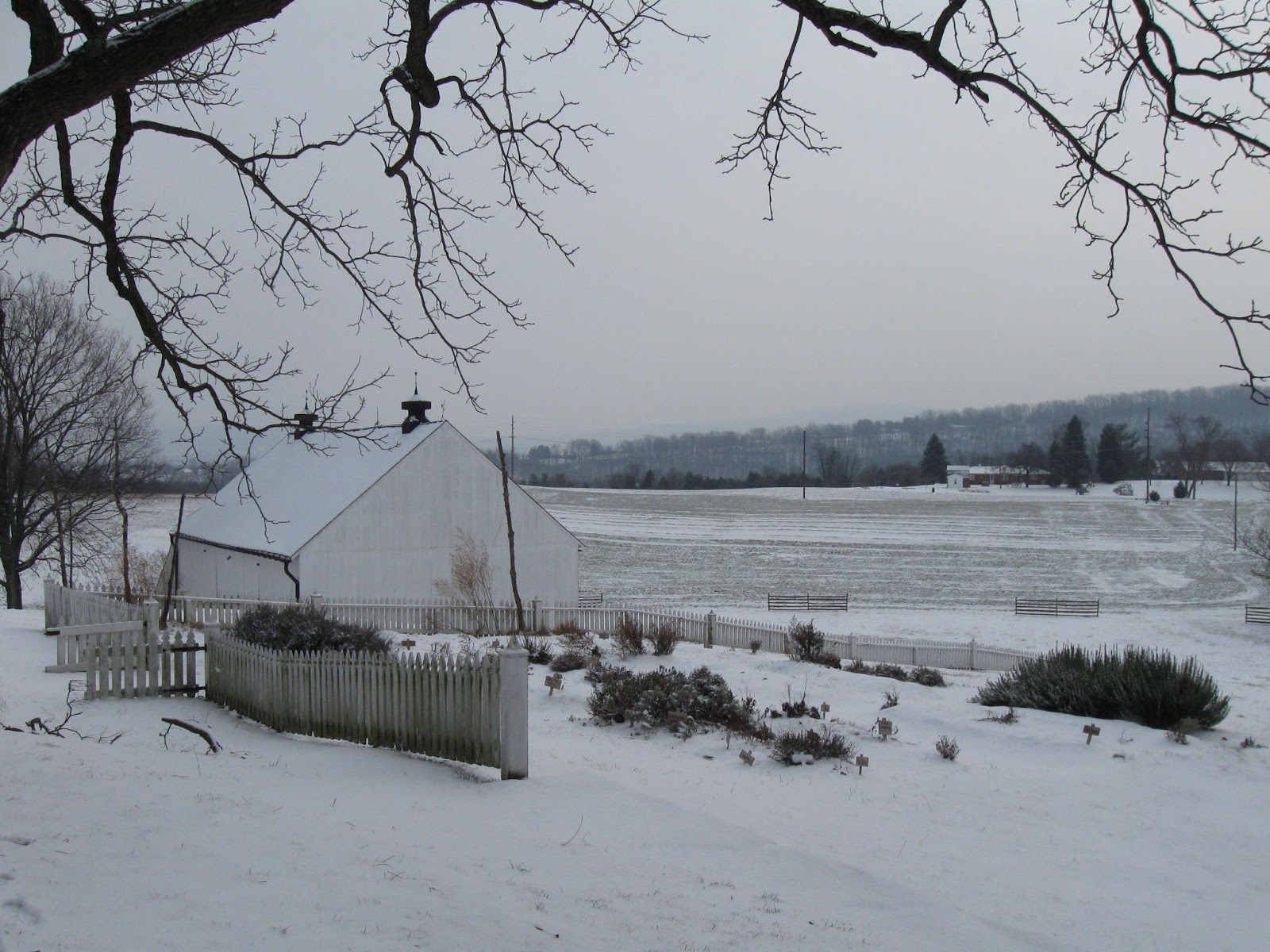
We had some snowy weather here at the Pry House during the end of last week. It made for an attractive view of the garden. It won't be long now before the garden is alive again with fresh green leaves. The weather is so lovely today and the birds are out and singing. It's hard to believe that it was so bitter cold here only a few days ago!

I thought I would post a few pictures from the recent snow, as well as some pictures I took after the Christmas snow last month.


From January:


From December:


Deer Tracks in the Garden